

by Josh Bays, on Nov 16, 2026, 7:00:00 AM
Data centers are overwhelming electric utilities with enormous power requests, and many of those requests will never be built. To protect themselves, electric utilities are asking every large power user to jump through vetting hoops as well as more firm downstream commitments.
In many locations, that has put manufacturing site selection projects in an awkward spot. Most utilities greatly value and don't want to burden manufacturing projects, but the rigid new rules don't always tell the difference. Here is what executives planning a power-intensive manufacturing plant should know.
What is Changing
Utilities are adding requirements designed to screen out speculative demand and mitigate the downstream risk of projects not coming to fruition:
- Study fees: Paying large up-front fees just to have the utility study a power request.
- Minimum bills: Paying for most of the reserved power, typically around 80%, whether it is used or not.
- Long contracts: Commitments that now often run 12 years or more.
- Collateral and exit fees: Cash or credit posted up front, and penalties for leaving early.
As of September 2026, 25 states have formally approved these rules, often called large-load tariffs, and seven more are considering them.
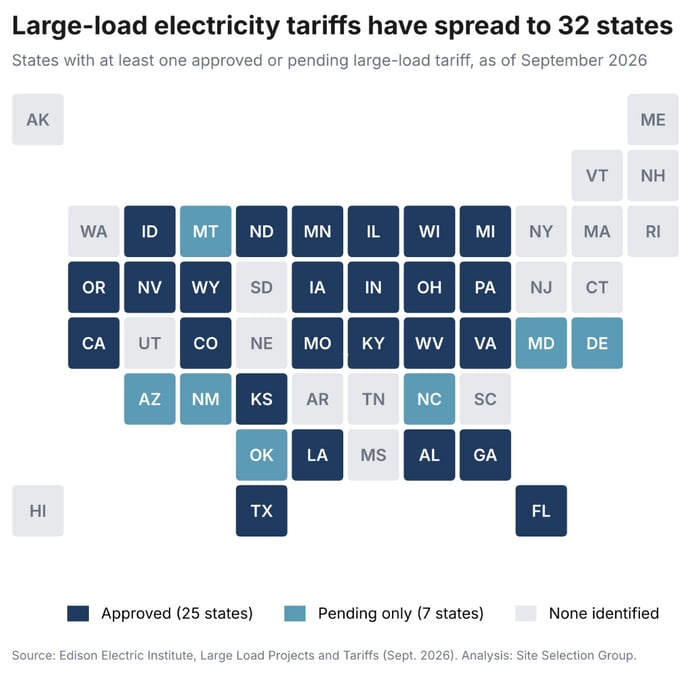
Takeaway: Confirming and securing power now often means demonstrating legitimacy and financial commitment.
Changing Rules May Apply to Manufacturers
Many utilities are trying to separate data centers from manufacturers (even if they are playing in the gray behind the scenes), but some are further along than others.
- What is helping manufacturers: Some utilities write separate rules for data centers, or apply their strictest terms only to facilities that run at full power around the clock.
- What is hurting manufacturers: Many rules are triggered by size alone, often around 25 MW, which many plants exceed.
- The gray area: Utilities generally try to spare manufacturers from study fees and strict terms, but it is not black and white. A large or vaguely defined request (or a perceived less-than-legitimate project) can be treated like a data center.
In Site Selection Group’s very active conversations with utilities across the country, the intent is consistent. Utilities want to accommodate manufacturers, even when their written policies have not caught up.
Takeaway: A project that has uncertainties like many data centers on paper will likely be treated like one.
What is at stake?
For a project that falls under these rules, the commitments add up:
Requirement |
Typical terms |
Business impact |
| Load studies | High initial study fees to confirm viability | Extends the site selection timeline and costs |
| Minimum bill | About 80% of reserved power | Paying for capacity you may not use |
| Contract length | 12 years or more | Less flexibility if plans change |
| Collateral | Often months to years of minimum bills | Capital tied up before production |
| Exit fees | Often years of minimum bills | A high cost to walk away |
Source: Lawrence Berkeley National Laboratory and The Brattle Group review of 55 tariffs, August 2026.
Takeaway: Two sites with similar power rates can carry very different long-term risk.
How Manufacturers Can Stand Apart from Data Centers
There is an art to positioning a project so it avoids hurdles meant for speculative demand. Site Selection Group recommends five steps:
- Know your power needs: Be precise about peak demand and how usage varies by shift and season.
- Phase the request: Tie power needs to a realistic production ramp instead of asking for everything on day one.
- Show the project is real: Defined specifications, realistic timelines, demonstrate project funding.
- Lead with jobs and investment: These matter to a utility's economic development team.
- Engage early and get it in writing: Ask which fees apply before the short list is final, and confirm any accommodation in the contract.
Takeaway: How a project is presented to the utility can matter as much as how much power it needs.
The bottom line
Utilities need firmer rules to manage data center demand, and most are working to keep those rules from burdening manufacturers. Until policies catch up, manufacturers need to show they are a different kind of customer.
At Site Selection Group, our technical site and infrastructure team evaluates utility capacity, cost and contract terms as part of every industrial project. If your company is planning a utility-intensive operation, the time to understand these rules is before the short list is set.
