

by Ceci Grover, on Mar 17, 2026, 7:00:00 AM
Site Selection Group, a full-service location advisory, economic incentives, and real estate services firm, helps manufacturing companies identify optimal locations through an objective, top-down approach to site selection. This process applies innovative analyses and filters to narrow the field of candidate geographies until the most competitive locations emerge.
One of the most critical proprietary tools used by Site Selection Group is GeoCision®, a weighted model that can score and rank candidate geographies based on pertinent site selection variables.
Ranking States by Competitiveness for Manufacturing Investment
Each year, Site Selection Group utilizes GeoCision® to score and rank states based on their competitiveness for corporate manufacturing investment (Best States for Manufacturing).
The process begins by scoring and ranking every metropolitan and micropolitan area (MSA) in the contiguous United States across key manufacturing variables. Those MSA scores are then averaged within each state to produce an overall state index.
While specific criteria vary by project, several core variables consistently drive manufacturing location decisions: access to qualified labor, competitive operating costs, and strategic geographic positioning.
Variables and Weightings Used in Site Selection Group’s Best States for Manufacturing
In our 2025 rankings, Site Selection Group scored states based on the following categories and weightings.
Category |
Weighting |
Key Variables |
| Workforce & Market Alignment | 40% |
|
| Operating Costs | 30% |
|
| Geographic Positioning | 30% |
|
Note: These rankings reflect Site Selection Group’s analysis of manufacturing competitiveness based on the most recent full-year data available for 2025.
2025 Best States for Manufacturing
The table and interactive map below show the results of the 2025 rankings.
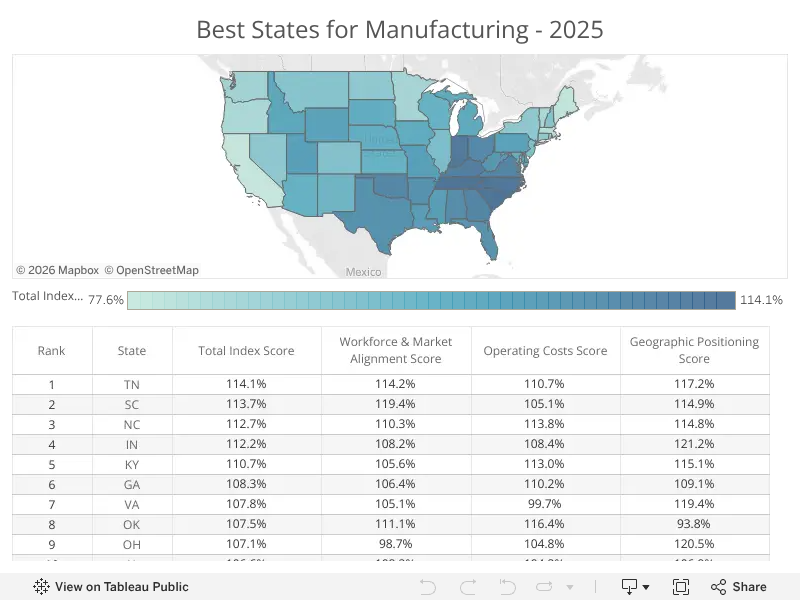
The top five states in Site Selection Group’s 2025 Best States for Manufacturing are:
- Tennessee
- South Carolina
- North Carolina
- Indiana
- Kentucky
The same five states that topped the manufacturing rankings in 2024 also lead in 2025, although their order has shifted slightly. The 2025 results also reinforce a broader geographic pattern that has persisted for several years: the Southeast and Midwest continue to dominate the U.S. manufacturing landscape.
Each of the top five states is located within these two regions, reflecting structural advantages that remain difficult for other parts of the country to replicate. These advantages include:
- Deep and scalable production labor pools
- Competitive wage structures
- Generally favorable labor environments
- Centralized access to major population centers
- Strong interstate and multimodal infrastructure networks
Unlike years that have seen meaningful shakeups in ranking composition, 2025 reflects:
- No new entrants into the top five
- No top-tier state falling materially
- No breakout movement from lower-ranked states
Instead, the data reinforces sustained structural strength among Southeastern and Midwestern states that continue to align closely with core manufacturing site selection priorities.
What This Means for Manufacturers
For companies evaluating expansion or relocation, the takeaway is clear: the states that consistently lead in manufacturing competitiveness are those that balance workforce scale, cost structure, and geographic accessibility.
While rankings provide directional insight, final site decisions remain highly project-specific. The optimal location will always depend on labor intensity, automation levels, logistics needs, and long-term operational strategy. Site Selection Group partners with clients to develop a comprehensive, project-specific analysis that identifies not only favorable states, but the precise markets, sites, and buildings best aligned with long-term operational goals.
