

by Chris Schwinden, on Jun 2, 2026, 7:00:00 AM
Workforce development has been a challenge for advanced manufacturing companies for years. Not only is workforce supply tight in many markets, but the technical skill set required for today’s advanced manufacturing operations continues to increase.
Across the country, Site Selection Group sees states, regions, and communities looking to meet that challenge by investing in resources such as K-12 programs, STEM, and technical training. One area that we see many communities and their partners promoting and investing in is apprenticeship programs. During Site Selection Group’s site visits with our corporate clients, we oftentimes hear communities pitch the opportunity that apprenticeship programs can offer companies that make a long-term investment in their future workforce, just like apprentices make an investment in their own training.
But one concern that Site Selection Group hears from many corporate clients is apprehension that apprenticeship programs are synonymous with organized labor presence, an important factor that many locationally active firms address in their site selection process. In this blog, we use two maps to explore whether that concern is justified and in which markets that concern is more salient.
Where Are the Most Entering Apprentices?
One of Site Selection Group’s workforce data partners, Lightcast, organizes current and historical apprenticeship data to show key trends. Much of this data is scattered across federal and state-level programs, so Lightcast’s organization and presentation of this information is very helpful.
The map below shows a count of entering apprentices for the most recent year of data (2025) by county, filtering out counties with very few entering apprentices.
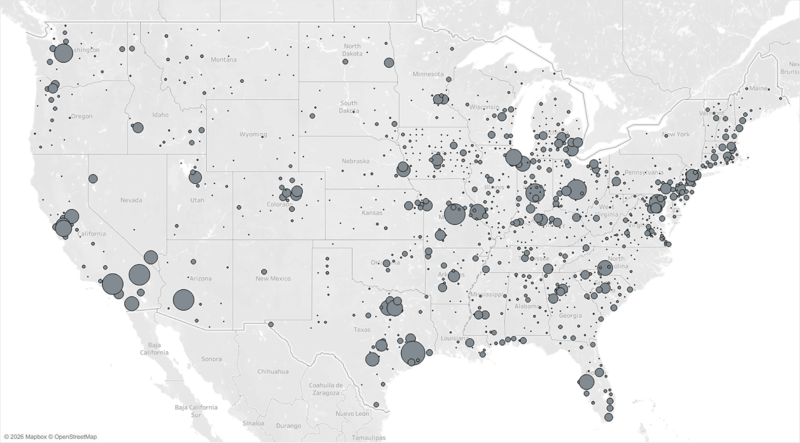
Not surprisingly, the number of entering apprentices tends to follow population patterns; more populated counties and metro areas tend to have more apprentices. But other data stands out:
- There’s a strong presence of entering apprentices in the industrialized Midwest (Illinois, Michigan, Indiana, Ohio, etc.). This comes as no surprise, as industries like automotive have leveraged apprenticeship programs for years.
- There are more surprising pockets of growth in apprentices entering smaller and mid-size markets. One that stands out immediately is that big “bubble” in the center of Missouri that includes Jefferson City, the state capital. Missouri has invested heavily in promoting private and public sector apprenticeship programs. The state of Missouri specifically has invested significant resources in its public-sector apprentice shop programs.
- Despite major growth in the advanced manufacturing industry in the Southeast, the number of entering apprentices is comparatively low. Of note, South Carolina has a stronger presence of apprentices.
Breaking it Down: Union vs. Non-Union Apprenticeships
One consistent challenge that Site Selection Group hears from its corporate clients during site visits is, “We’d love to work with community partners to develop apprenticeship programs, but aren’t they all associated with unions?” In fact, from time to time, Site Selection Group has clients that have a negative impression of a community with a strong apprenticeship program, thinking it’s a Trojan horse for future labor organization attempts.
This is a complicated question to answer, but fortunately, the Lightcast apprenticeship data breaks out entering apprentices who are union-sponsored vs. non-union-sponsored. The map below shows that breakdown, with orange showing the number of entering apprentices that are union affiliated, and those in green showing ones that are nonunion (open shop).
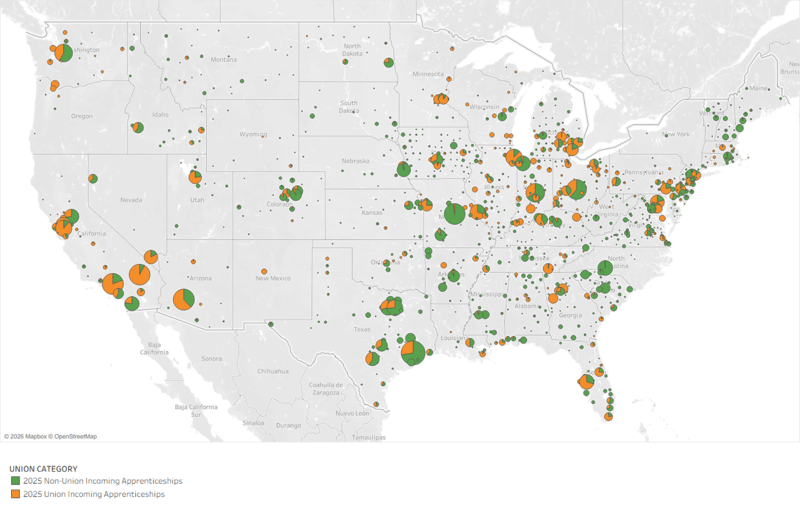
Here, we see where some of those assumptions about the connection between organized labor and apprenticeship programs are justified, and where the data is more mixed. For example:
- Most entering apprentices in regions with a high organized labor presence, e.g., California, Minnesota, Michigan, and Chicagoland, are more associated with unions.
- But other locations that historically have a higher organized labor presence have a mix between union and nonunion apprenticeships (e.g., Indiana, Ohio, Missouri).
- There are regions and states with a large number of entering apprentices, but most of which are nonunion. Areas like South Carolina, greater Charlotte, and Texas stand out.
It’s Important to Understand the Details of Apprenticeships
There’s a lot more to review when it comes to evaluating the advantages and challenges of investing in an apprenticeship program, but hopefully the two maps above show that it’s not quite so simple to say apprenticeships equal unions.
Site Selection Group encourages our corporate clients to dive deep into prospective state and community apprenticeship programs and ask good questions to determine whether those programs are aligned with their own. And we highly encourage economic developers and their partners to be very clear on which type of companies in their regions sponsor apprenticeships.
Site Selection Group thinks that apprenticeships can be a valuable workforce development tool for some, and we don’t want misinformation to get in the way of making an informed decision.
