

by King White, on Sep 18, 2026, 7:00:01 AM
The Federal Communications Commission (FCC) is no longer just talking about onshoring customer service. In March 2026, the FCC adopted a Notice of Proposed Rulemaking (NPRM) that would cap how much call volume providers can route offshore, require agents to disclose their location at the start of every call, give consumers the right to transfer to a U.S.-based representative, and bar the use of call centers in countries designated as foreign adversaries. Comments and reply comments have already closed. The FCC hasn't issued a final order, but Washington's direction is clear.
Companies waiting for a final rule before they act are giving up the one advantage they actually have right now: time. Whatever percentage cap and compliance window the FCC ultimately adopts, the operational moves needed to comply—hiring, site selection, vendor transitions, technology cutover—take months to plan and longer to execute. Below is a 10-step framework for building that plan today, regardless of exactly how the rule lands, so the work is already underway by the time the compliance clock starts.
Where the Rule Stands Today
The NPRM, formally titled Improving Customer Service and Protecting Consumers Through Onshoring, was adopted March 26, 2026, and published in the Federal Register in April. It directly covers providers of telecommunications, wireless, VoIP, cable, and satellite broadcast services, but the FCC has explicitly asked whether the same requirements should extend to other industries and to nonvoice channels like chat, email, and text—a sign the scope could widen well beyond traditional telecom. Comments closed in late May, reply comments in June 2026; a final order is still pending.
Four provisions matter most for planning purposes:
- A cap on the share of customer service calls handled offshore, with 30% floated as a potential threshold
- Mandatory English-proficiency standards for offshore agents
- A required at-call disclosure of agent location paired with a consumer right to transfer to a U.S.-based representative
- A prohibition on using call centers in foreign-adversary countries, with the FCC also asking whether that prohibition should extend to any call center employing citizens of those countries, wherever it's located.
Handling of sensitive consumer data would also be restricted to U.S. soil, separate from whatever the overall offshore cap turns out to be. The FCC hasn't settled on a compliance timeline either, but it specifically asked commenters how long a transition period providers would need—an indication that a phased effective date, not an overnight switch, is the likely outcome.
A 10-Step Framework for Getting Ready
The logic here matters as much as the list. Size what you actually have exposed, and what you're contractually locked into, before you touch anything else. Shrink that volume with technology before you build a staffing model to serve it. Then design the delivery model, decide on sourcing, pick a location, and only then build the cost case that turns several defensible options into one recommendation.
1. Quantify your exposure.
Determine what share of your inbound and outbound customer service volume currently touches an offshore call center, broken out by call type—billing, technical support, sales, collections—and by whether the call involves sensitive data. This baseline is what any percentage cap or sensitive-data rule will be measured against, and every later step scales from this number.
2. Audit your existing vendor contracts.
Before you plan a transition timeline, find out what timeline your current offshore agreements actually allow. Pull the termination clauses, notice periods, minimum volume commitments, and exit costs on every offshore BPO contract in place. A well-designed reshoring plan can still be stuck behind a four-year agreement with a steep early-termination penalty, and that constraint should shape your timeline before the FCC's does.
3. Evaluate technology deflection first.
Before staffing a single new seat, look at how much of your baseline volume can be resolved without a live agent at all. AI-driven virtual agents, self-service portals, and IVR-based automation can now deflect a meaningful share of routine billing and status inquiries before they ever reach a queue. Sizing this reduction first shrinks the headcount, facility, and cost problem every later step has to solve.
4. Choose a delivery model.
For the call volume that still needs a live agent, there are three broad paths: a captive site staffed by your own employees, a work-from-home agent model, or a hybrid of the two. Each carries different real estate, technology, security, and management implications, and most companies land on some blend rather than a single pure model.
5. Weigh domestic outsourcing alongside captive.
A domestic BPO is a fourth option layered on top of the first three, and for most companies it won't be all-or-nothing. Decide which call types are sensitive, complex, or brand-critical enough to keep captive, and which are standardized enough to hand to a BPO partner. Keep the learning curve in mind. Agents new to your product or policies typically ramp faster on-site with direct coaching, so even a BPO-heavy long-term plan may need to start on-site before agents earn the track record to move remote.
6. Select U.S. locations with labor cost in mind.
Once you know roughly how much captive and BPO capacity you need, site selection becomes a labor-cost exercise. Wage rates for comparable contact center roles can vary 10% to 20% between U.S. markets, and that spread compounds quickly at scale—a few points of labor-cost difference on a 500-seat operation is a real line item, not a rounding error.
7. Model the budget and cost comparison.
With a delivery model, a sourcing split, and target markets identified, model the full cost of each realistic scenario side by side: facility and technology costs for captive, contract rates and management overhead for BPO, wage differentials by market, and the one-time costs of getting there, including whatever you learned in step 2 about exiting current contracts.
8. Build the implementation plan.
Translate the chosen scenario into a sequenced plan—hiring and training timelines, technology cutover for disclosure and transfer-right requirements, site buildout or BPO contracting, and a compliance calendar tied to whatever transition period the FCC ultimately adopts.
9. Secure board and executive approval.
Bring the recommendation, the cost comparison, and the implementation timeline to leadership as a single package. A rule that touches headcount, real estate, technology spend, and vendor contracts is a capital and operating decision, not just a compliance checkbox.
10. Implement—and monitor.
Execute against the approved plan and build in ongoing tracking from day one: your offshore percentage against whatever cap is finalized, disclosure delivery on covered calls, and service levels on transfer requests. If the final rule carries reporting obligations, as several of the FCC's own questions in the NPRM suggest it might, you'll want that data already flowing rather than built from scratch under a deadline.
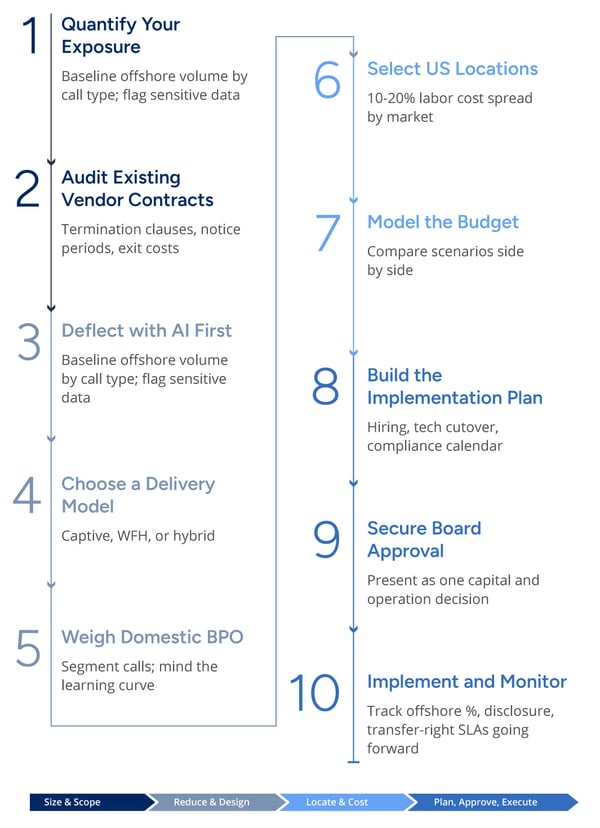
Not all 10 steps take equal time, and several can run in parallel rather than in strict sequence. The contract audit (step 2) and the technology deflection review (step 3) can both start the same week as the exposure baseline, since neither depends on the other's outcome. Site selection and budget modeling, by contrast, need the delivery-model and sourcing decisions locked first. Running those out of order is one of the more common reasons reshoring projects run over both budget and schedule.
The Trade-Off Worth Naming
Onshoring isn't free, and it's worth saying so plainly. Domestic labor costs run well above many offshore markets even after accounting for productivity differences, and a wave of companies moving in the same direction at once will tighten competition for experienced U.S. contact center talent and squeeze available domestic BPO capacity. There's a relationship cost too. Unwinding a long-tenured offshore partnership isn't just a line on a budget; it means losing institutional knowledge and vendor goodwill that took years to build. Building in lead time now, rather than waiting for a final rule and a compliance clock, is the best lever available to manage all three.
Where an Outside View Helps
This is exactly the kind of decision where an advisor without a stake in the outcome earns its keep. Site Selection Group works both sides of this market: helping companies plan location and sourcing strategy for reshored contact center operations, and helping domestic BPOs plan their own site selection as demand grows. If you're starting to model what this rule could mean for your operation, now is the time to have that conversation, not after the final order is on the books.
