

by Jake Wilson, on Feb 23, 2026, 6:59:59 AM
Three straight years of rising U.S. industrial vacancies have shifted negotiating power from landlords to tenants. While many tenants with long-term leases rolling in the near term are still contending with higher rents driven by record post-pandemic rent growth, today’s elevated vacancy levels provide tenants with significantly more leverage in lease negotiations than they have had in recent years.
In contrast to the highly competitive landlord-favored market of 2021–2022, tenants now have more options, longer decision timelines, and increased flexibility when evaluating space.
At Site Selection Group (SSG), we monitor these trends closely to help our clients secure favorable lease terms in this evolving environment.
Rent Growth Has Stalled
National industrial rent growth reached record highs in 2022 but has since slowed considerably. Over the past 12 months, year-over-year rent growth has decelerated to approximately 1.4%, its lowest level since 2012. Notably, the fourth quarter of 2025 saw 0% rent growth, marking one of the first quarters in recent history in which rents remained flat.
Looking ahead, continued economic uncertainty—including interest rates, consumer spending, and global trade—will influence market direction. Should vacancy rates continue to rise, the market could experience its first decline in average industrial rents since the Great Recession in 2008.
Supply Slows as Developers Pull Back
Following an unprecedented surge in industrial construction beginning in 2021, development activity peaked in the third quarter of 2022, with approximately 170 million square feet breaking ground nationwide. Deliveries reached their high point in late 2023 and have steadily declined since.
Although the industrial sector remains fundamentally healthy, the volume of new supply delivered over the past several years outpaced demand, pushing national vacancy to a record 7.6%. In response, developers have significantly reduced new construction starts. Quarterly net supply additions are now projected to fall below the pre-pandemic three-year average, and annual deliveries are expected to reach a 10-year low by year-end.
Slower absorption, coupled with higher construction costs and rising exit cap rates, suggests this pullback in development will persist until vacancy meaningfully declines.
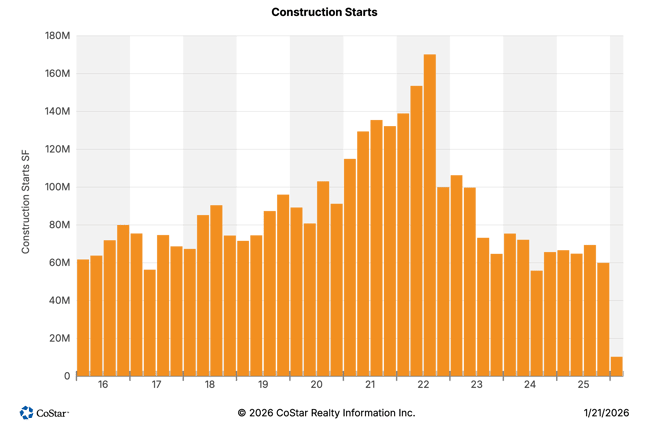
Source: Costar
Market Trends Vary Significantly Among Different Building Sizes
Not all industrial product is performing equally. While national averages reflect higher vacancy rates and stabilizing rents, small-bay industrial buildings remain a clear outlier.
Large-format logistics facilities—typically those exceeding 100,000 square feet—are driving much of the increase in vacancy, as they have absorbed the bulk of recent speculative development. In contrast, small-bay buildings continue to experience low vacancy due to limited new supply and consistent demand from local service, distribution, and light manufacturing users.
The table below shows how building size correlates to vacancy rates and average time on market.
Size |
Vacancy Rate |
Time on Market |
| 100,000 + SF | >9% | 8+ months |
| 50,000 – 100,000 SF | 6.50% | 6.2 months |
| < 50,000 SF | <5% | 5 months |
Markets Experiencing the Highest Vacancy
Among U.S. industrial markets with more than 100 million square feet of inventory, the following currently exhibit the highest vacancy rates:
Market |
Vacancy Rate |
Available SF (Direct) |
| Charleston - SC | 14.70% | 16,770,188 |
| Austin - TX | 13.50% | 30,016,430 |
| San Francisco - CA | 13.50% | 13,277,622 |
| Savannah - GA | 12.30% | 21,040,705 |
| Phoenix - AZ | 12.00% | 63,547,030 |
| Reno - NV | 11.80% | 15,590,875 |
| Las Vegas - NV | 11.60% | 22,630,034 |
| Stockton - CA | 10.60% | 13,056,737 |
| San Antonio - TX | 10.60% | 22,467,351 |
| Charlotte - NC | 9.70% | 39,757,705 |
| Lehigh Valley - PA | 9.70% | 18,345,131 |
| Jacksonville - FL | 9.70% | 20,200,397 |
| Spartanburg - SC | 9.70% | 11,009,414 |
| Worcester - MA | 9.60% | 11,898,854 |
| Seattle - WA | 9.60% | 37,720,878 |
Source: Costar
Global and Political Factors Add to Uncertainty
Beyond supply dynamics, the industrial market is also being influenced by geopolitical and macroeconomic factors. Ongoing tariff policies and global trade disruptions have contributed to a decline in U.S. imports, directly impacting demand for logistics and distribution space. Additionally, reduced consumer spending and broader economic caution may further soften near-term demand.
At the same time, increased focus on domestic manufacturing and reshoring initiatives could drive future demand for production and specialized industrial facilities. Regardless of how political and global factors ultimately play out, new construction is expected to remain constrained until absorption improves and vacancy tightens.
What Tenants Need to Know
The industrial leasing landscape today looks vastly different from what it did just a few years ago. Landlords are facing higher vacancy, longer marketing periods, and increased competition. As a result, many are offering more aggressive concessions, including free rent, higher tenant improvement allowances, and increased flexibility on deal terms.
While tenants may still experience sticker shock from the rent escalations of recent years, today’s softer market conditions provide meaningful opportunities. Increased vacancy and slower rent growth give tenants leverage to negotiate more favorable economics and secure space that may not have been available in prior cycles.
How to Capitalize on Current Conditions
Now is the time for tenants to act. Whether negotiating a new lease or preparing for a renewal, early planning is essential to maintaining leverage. SSG helps clients:
- Understand local market trends
- Identify and evaluate alternative buildings
- Assess landlord financials and loan maturities
The oversupply presents a rare opportunity for tenants to lock in more favorable terms. With the right strategy, tenants can turn today’s market conditions to their advantage.
